Trupanion Spent $25 Million Buying Back Its Own Stock in Q3 as Cash Flow Hit a RecordSugar Paws launches six shampoos and matching sprays into the specialty grooming aisleMonic Group moves founding family to board level as two internal operators take the helmGralen picked up Snappy Tom distribution for late 2026 US specialty launchBlue Cross received 25,000 rehoming requests this year, up 38% from last yearSonoco publishes verified emissions data and automated LCA reports for packaging customersPet Sustainability Coalition Named Six Award Winners From Its Accredited Member PoolREWE Group scales pet retail across grocery, DIY, and standalone ZooRoyal stores in GermanyTrupanion Spent $25 Million Buying Back Its Own Stock in Q3 as Cash Flow Hit a RecordSugar Paws launches six shampoos and matching sprays into the specialty grooming aisleMonic Group moves founding family to board level as two internal operators take the helmGralen picked up Snappy Tom distribution for late 2026 US specialty launchBlue Cross received 25,000 rehoming requests this year, up 38% from last yearSonoco publishes verified emissions data and automated LCA reports for packaging customersPet Sustainability Coalition Named Six Award Winners From Its Accredited Member PoolREWE Group scales pet retail across grocery, DIY, and standalone ZooRoyal stores in Germany
Purina's Petivity puts a facial-recognition cat feeder on Amazon and Chewy
The Smart Feeder for Cats identifies up to five cats, tracks portions, and is for sale now on the two biggest online pet shelves. Independent retailers are not on the launch list.
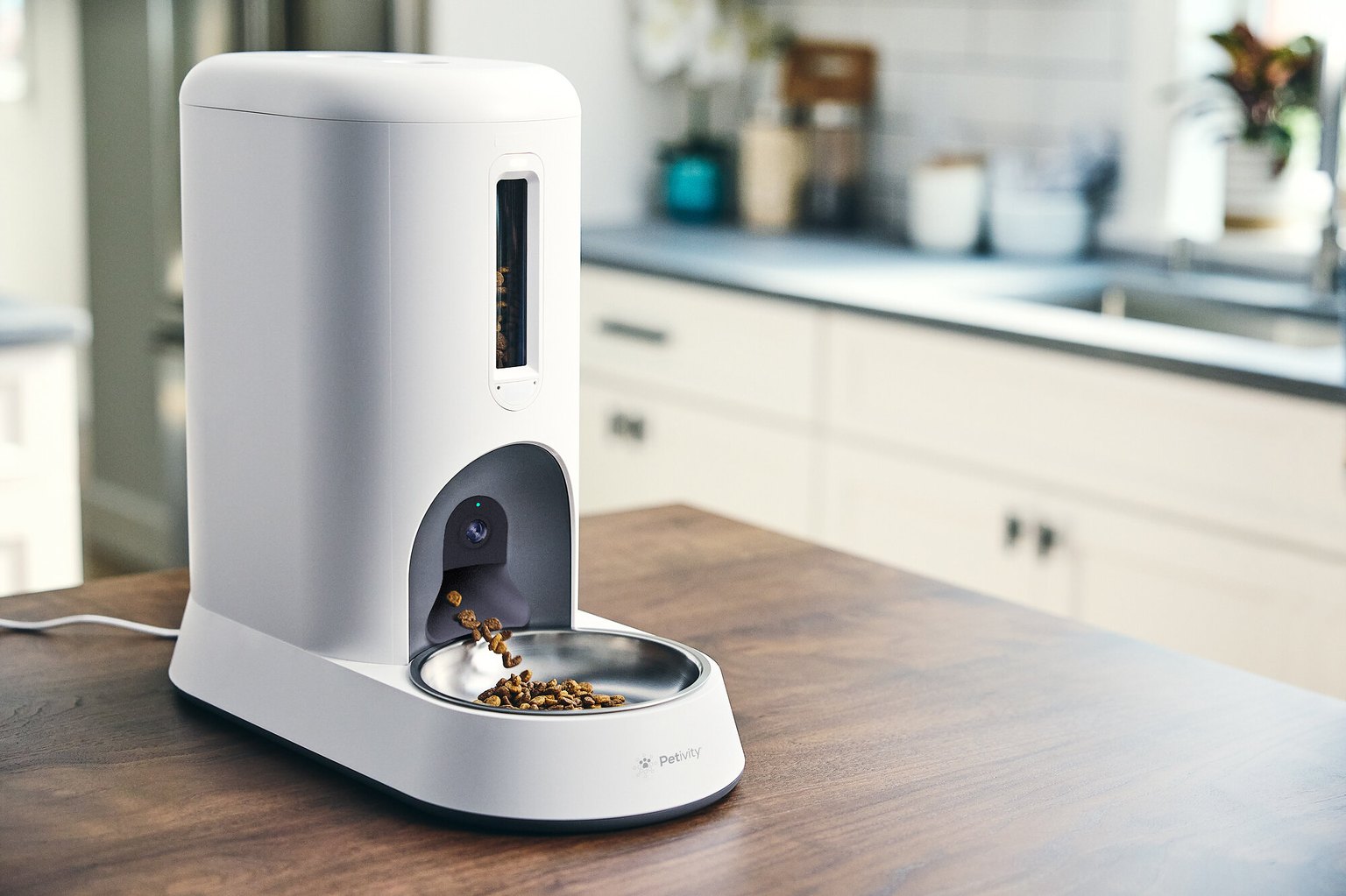
Photo courtesy of Petivity
Petivity, the Purina brand built around connected cat care, has launched a Smart Feeder for Cats that uses a camera and sensors to recognize individual cats and log what each one eats. Petfood Industry reported the launch on September 21. The unit is for sale now on Amazon, Chewy, and Petivity.com.
Independent retailers were not named as launch partners.
The feeder is aimed at multi-cat homes, where portion control often fails for a simple reason: the person filling the bowl cannot tell which cat ate which meal. Petivity says the device can identify up to five cats by facial recognition, then track portion size, eating frequency, and feeding patterns over time. Owners can set schedules, trigger a feeding remotely, check a live video feed in the Petivity app, and get a low-kibble alert. The food container, carousel, and bowl are dishwasher-safe, and the bowl is shallow and low-profile, a design the company says is meant to reduce whisker fatigue.
Kristin Slater, Petivity's product development lead, tied the product to a health problem specialty already sells against: "How and when your cat eats may matter just as much as what they eat." Obesity, she said, "is one of the most common, preventable health issues in cats, often because parents don't know how much their cat is eating." The feeder can also pair with the Petivity Smart Litter Box Monitor, so intake and elimination sit in the same dataset.
Those are useful features, and they come from a company with more training data than a typical gadget startup can claim. Petivity said the feeder's system was trained on more than 21,000 real-world feeding sessions, more than 1,400 hours of video, and images of more than 15,000 cats, and that the design went through more than 10 iterations. During development, the company said, 99.5% of cats ate from the feeder. Dr. Natalie Langenfeld-McCoy, a Purina data scientist, said the team spent years reviewing feeding sessions and video "to make sure this feeder truly understands cat behavior." Those figures are Petivity's and Purina's, reported by Petfood Industry. The launch coverage did not include a retail price.
The go-to-market is the part that should matter to a specialty buyer. A Purina-backed connected feeder, sold first on Amazon and Chewy, is a reminder of how often hardware that sits next to the food lands on the internet aisle before it lands on an independent shelf. Petivity is also marking the launch with a public event in New York on October 6, from 10 a.m. to 7 p.m. EDT, in Vanderbilt Hall at Grand Central Terminal. Visitors who press a button will trigger a Smart Feeder at a partner shelter, with the meal shown live. The named partners are Atlanta Humane Society, Cat Adoption Team in Sherwood, Oregon, and Tree House Humane Society in Chicago. That is a brand event, not a wholesale launch.
For independent stores, the gap is practical. Multi-cat households are already in the aisle, already buying weight-management and veterinary diets, already asking why one cat is gaining while the other is not. A feeder that assigns portions to the right animal is a natural add-on to that conversation, the same way a microchip-activated or RFID feeder has been for years. If the only places a customer can buy the Petivity version are Amazon, Chewy, and the brand's site, the store can recommend the category and still lose the ticket.
There is also a merchandising risk in sending that customer online. Once they are on Chewy or Amazon for the feeder, the food refill is one click away, in the same account, often on a subscribe-and-save plan. A connected feeder is not a toy. It is infrastructure for the meal, and the company that owns the feeder has a standing invitation to own the kibble.
It is worth being precise about what this launch does and does not prove. Facial recognition in a feeder is no longer a CES novelty. Cheerble spent January making a similar claim for a six-cat unit that had not yet opened preorders. Petivity is later in the year, with a Purina badge, a pairing path to a litter monitor, and, critically, live listings at the two retailers that already own a large share of online demand. The product may be better, or it may simply be better distributed. Either way, the specialty store is watching the category get defined somewhere else.
Specialty's opening, if there is one, is the conversation Purina cannot have at a warehouse locker: which cat is actually eating the diet you just recommended, what to do when recognition fails, and whether this feeder, at whatever price the Amazon and Chewy listings settle at, is the right next step versus a simpler gated feeder. Stores that already sell microchip feeders should treat this launch as a category check, not a passing gadget note. Ask your Purina or Petivity rep whether specialty distribution is planned, on what terms, and whether the litter-box monitor is part of the same pitch. Until that call has an answer, the Smart Feeder for Cats is a product you will explain and someone else will ship.
Petfood Industry's September 21 report is the source for the product details, the training figures, the Slater and Langenfeld-McCoy comments, the October 6 event, and the Amazon, Chewy, and Petivity.com availability. A selling price was not included in that report.
Get the next issue in your inbox. Free, weekly, no fluff.